
TL;DR: Deepfake CFO fraud is a scam in which an attacker uses a cloned voice or a live face swap to pose as a finance leader and ask treasury or accounts employees for an urgent payment or a change to bank details. It works because the request looks routine, the voice sounds right and the caller adds pressure. Training finance teams to stop it means practising one habit on realistic calls. Pause any unusual payment request made by voice or video, hang up, and confirm it through a channel you already trust.
Why treasury teams are now the front line
Treasury and finance teams have always been a target, because they are the people who can move money. What has changed is the voice on the other end of the line. An attacker no longer has to write a convincing email and hope nobody checks the sender. They can call, or join a video meeting, sounding and looking like the chief financial officer.
Our view is that the weak point is not the payment system. It is the people who operate it, and the pressure they are put under when a senior voice asks for something quickly. Firewalls and approval software do not hear a phone call.
This post explains how deepfake CFO fraud works against treasury and accounts teams, why it lands even with careful, experienced employees, and how to train those employees to stop it before money leaves the business.
How a deepfake CFO fraud call is put together
The scam is built in a few ordinary steps. None of them needs special skill.
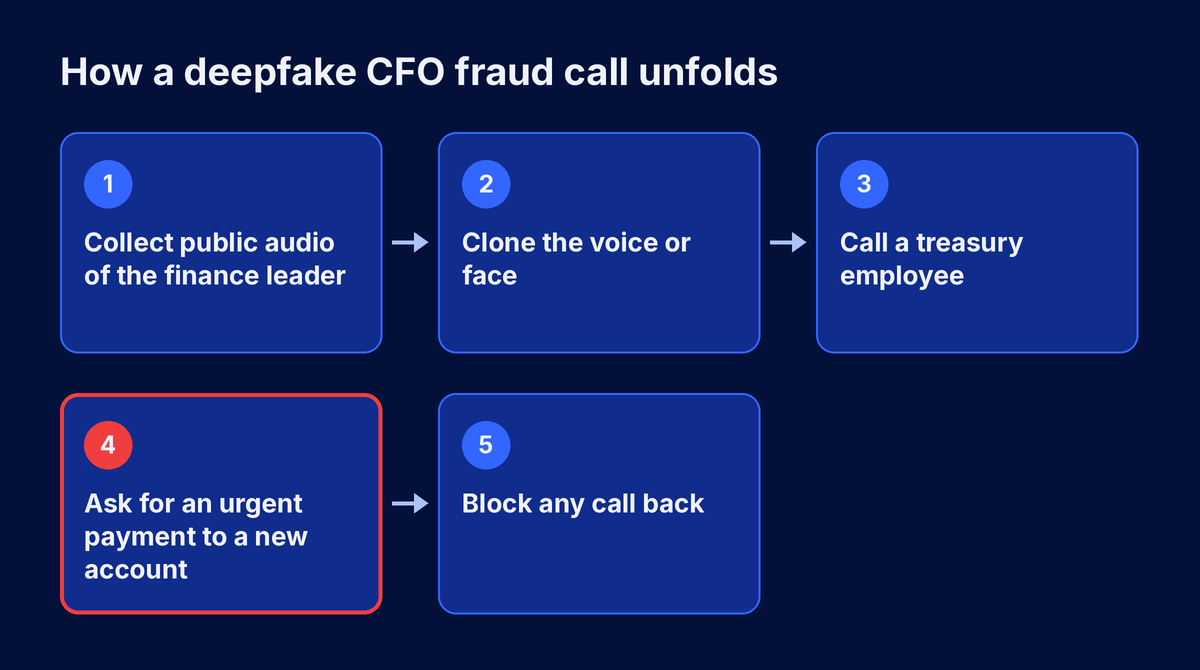
First, the attacker collects material. Finance leaders speak on earnings calls, at conferences, in company videos and on podcasts. A short clip of clean speech is enough to clone a voice, as our post on how much audio it takes to clone a voice explains. A clear photo is enough to swap a face onto a live video feed.
Second, the attacker learns the routine. Who approves payments, which suppliers are paid often, when the quarter closes, who is travelling. Much of this sits on professional networking profiles, press releases and supplier websites.
Third, the call. It usually comes at a busy moment, near a deadline or late on a Friday. The cloned voice asks for something that sounds plausible. Pay this supplier today because the old account has been closed. Release funds for a confidential deal that cannot go through the usual approvals yet. Change the bank details on file before the next payment run.
Finally, the attacker closes the exits. The caller is about to board a flight, or in a meeting with the board, or bound by a confidentiality agreement. Calling back is discouraged. Telling anyone else is discouraged. The request has to happen now.
Why it lands with careful finance employees
People who work in treasury are trained to spot fraud. They know about fake invoices and spoofed emails. So why does a phone call still work?
The first reason is trust in the voice. Hearing a familiar voice is far more persuasive than reading a familiar name in an email. Most employees have never been told that a voice can be copied, so they have no reason to doubt it.
The second reason is authority. A request from the chief financial officer is not one an accounts employee expects to question. Challenging it can feel like a risk to their career, especially when the caller sounds impatient.
The third reason is urgency. A deadline removes the time employees normally use to check. The attacker wants a decision made inside the call, before anyone else hears about it.
The fourth reason is process. Many payment workflows allow an exception when a senior leader asks for one by phone. That exception is exactly the gap the attacker is aiming at. If the process says a phone call can override the usual checks, a cloned voice can override them too.
How to train finance teams to stop deepfake CFO fraud
Detection is not the goal. Cloned voices keep improving, and asking employees to listen for a slightly robotic tone sets them up to fail. The goal is a habit that works however good the fake becomes.
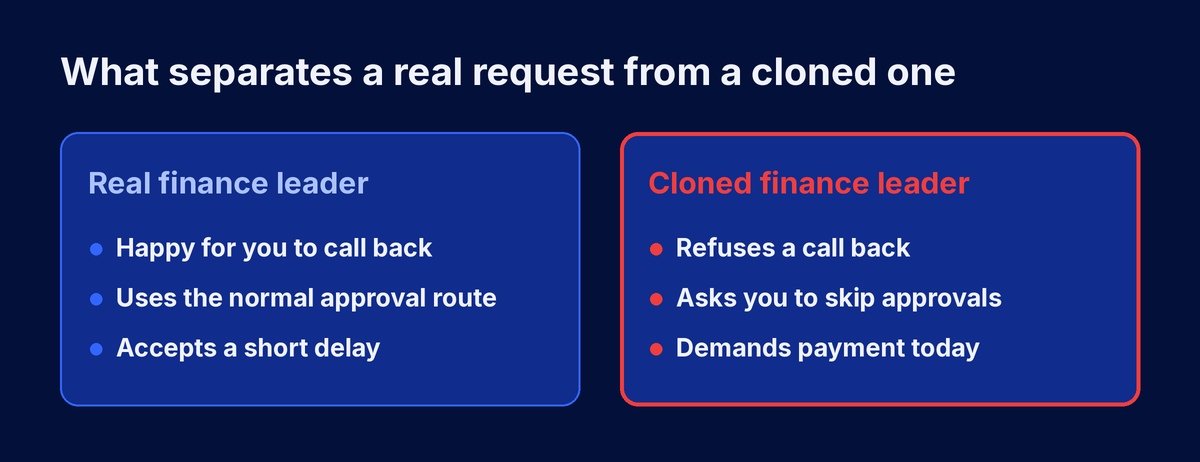
That habit has four parts. Pause when a payment request arrives by voice or video and feels unusual. Hang up, or leave the meeting. Call back on a number you already have, not one the caller gives you. Report the call, whether it was real or not. Write this into the payment procedure so that an employee who follows it is never in trouble for delaying a real request.
Then make the habit easy to follow. Agree a verification phrase with finance leaders for out of hours requests, but treat it as an extra check and never a substitute for the call back. A caller who knows the phrase still gets a call back on a number already held before any payment is made. Require a second approver for any new beneficiary or change of bank details, with no exception for urgency. Tell executives that their own teams will call them back, and ask them to welcome it.
Finally, practise. A policy that has never been tested under pressure is a hope, not a control. Employees need to hear what a convincing cloned voice sounds like in a safe setting, on a call that feels real, and then be told straight away what gave it away and what they should have done. That is the difference between knowing the rule and following it when a senior voice is in a hurry.
Good practice for finance teams looks like this. Run simulated calls only with employees who have agreed to the training programme, and only with the consent of any executive whose voice is imitated. Use the requests treasury really receives, such as a supplier bank change or an urgent transfer before a deadline. Stop the call the moment the employee asks to verify. Explain the simulation straight afterwards. Repeat it over several months with different pretexts, and read the results by team rather than by person so that weak processes get fixed instead of individuals blamed.
Our page on security awareness for financial services covers how this fits the wider risks finance teams face, and the page on deepfake executive protection covers the leaders whose voices are most often borrowed.
What to change in the payment process
Training works best when the process backs it up. Three changes close most of the gap.
Remove the phone exception. No payment to a new account, and no change of bank details, should be approved on the strength of a voice or video call alone, however senior the caller.
Separate the request from the confirmation. The channel used to confirm a request must never be one the requester supplied. A call back to a number held on file, or a message through an internal system, breaks the scam because the attacker does not control that channel.
Make delay safe. Leaders should say clearly, and more than once, that they would rather wait an hour than lose a payment to fraud. Employees who hear that from the top are far more likely to pause when it matters.
Deepfake CFO fraud succeeds when a trusted voice, a busy moment and a flexible process meet. Training finance teams to pause and verify through a channel they already trust, and backing that habit with a process that never accepts a call as proof, takes away all three.
Frequently Asked Questions
Q: What is deepfake CFO fraud?
A: Deepfake CFO fraud is a scam in which an attacker clones the voice or face of a finance leader and uses it on a call to ask treasury or accounts employees for an urgent payment or a bank detail change. The cloned voice makes a routine looking request feel genuine and hard to refuse.
Q: Why are treasury teams targeted by deepfake scams?
A: Treasury teams can move money, and their payment processes often allow exceptions when a senior leader asks by phone. Attackers aim at that exception. Finance leaders also speak publicly, which gives attackers the audio they need to clone a convincing voice for the call.
Q: How do you train employees to spot a deepfake CFO call?
A: Train a habit rather than detection. Employees pause any unusual payment request made by voice or video, hang up, call back on a number they already hold, and report the call. Practise it on realistic simulated calls, with consent, and explain the simulation straight away so the lesson sticks.
Q: What payment controls stop deepfake CFO fraud?
A: Require a second approver for any new beneficiary or bank detail change, with no exception for urgency. Confirm requests only through a channel the requester did not supply, such as a number held on file. Make clear that delaying a payment to verify it is always the right call.
Try the free demo before your finance team meets the real thing
The quickest way to understand the risk is to experience it. Take the free deepfake security training demo yourself, then share it with the people in your business who approve payments.
Share this article
Found it interesting? Don't hesitate to share it to your friends or colleagues