
TL;DR: Deepfake CEO fraud is a scam in which an attacker uses a cloned voice or a live face swap to pose as a chief executive, then hands the employee to a second impostor, often a lawyer or adviser, who runs the request. The pair invoke a confidential deal, forbid the employee from telling colleagues, and push for a payment or sensitive data. It works because each caller vouches for the other. Training should teach employees that secrecy plus urgency is the signal, and that every request is confirmed through a number they already hold.
Why deepfake CEO fraud now comes with a supporting cast
The classic chief executive scam was a single message. An email from a lookalike address asked someone in finance to pay an invoice quietly before the end of the day. Employees learned to check the sender, and the scam adapted.
The version employees face now is a performance with several roles. The first call or video meeting comes from someone who looks and sounds like the chief executive. Their voice has been cloned from public recordings, or their face has been swapped onto a live video feed. They explain that something sensitive is under way, an acquisition, a regulatory matter or a dispute, and that an outside lawyer will be in touch with the details.
Then the lawyer calls. The lawyer is the one who asks for the money, the documents or the access. The chief executive never asks for anything directly. That split is deliberate, and it is what makes this scam harder to spot than a single impostor.
This post explains how the two caller script works, why it lands on careful people, and how to train employees to stop it without making them suspicious of every senior colleague.
How the fake lawyer script works, step by step
The script follows the same shape whatever the story. Each step is designed to remove one of the checks an employee would normally make.
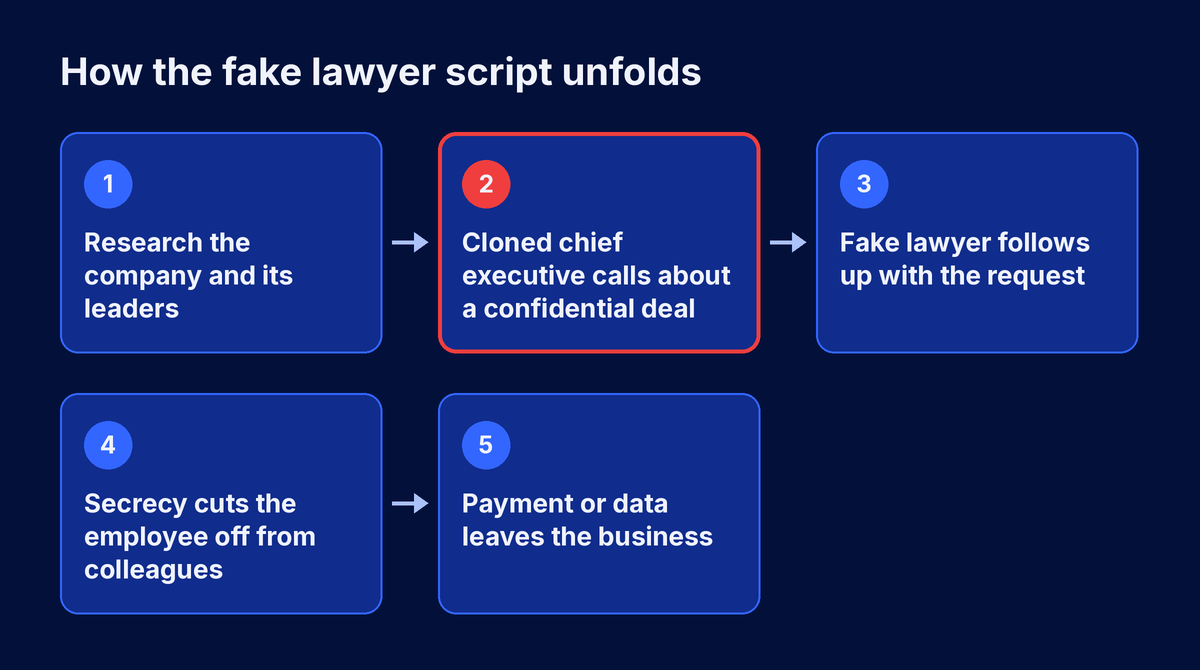
First, the attackers research the business. They learn who the leaders are, who handles payments or sensitive files, and what the company has said in public about deals, offices or partners. Interviews, conference talks and company videos give them both the context and the voice.
Second, the cloned chief executive makes contact. The call is short. It sets the scene, flatters the employee for being trusted with something important, and names the lawyer who will follow up. Keeping the impostor on the line briefly makes the deepfake harder to catch, because there is less time for a slip in tone or a question it cannot answer.
Third, the lawyer calls, often from a number that looks local or from what seems to be a law firm. The lawyer sounds calm and professional, uses the right vocabulary and sends official looking paperwork. Because the chief executive has already vouched for them, the employee does not question who they are.
Fourth, the lawyer insists on confidentiality. The employee is told that the deal is market sensitive, that colleagues must not know, and that breaking the silence could cost the company the deal or break the law. This step quietly disables the most effective defence a business has, which is a second person looking at the request.
Finally, the request arrives. It might be a transfer to an escrow account, a change to a supplier's bank details, a set of customer records or access to a system. By the time it arrives, the employee has been made to feel that saying no would be the risky choice.
Why the two caller pattern lands on careful employees
Most awareness training teaches employees to judge a single caller. Is the voice right, is the request normal, does the story hang together? The fake lawyer script answers each of those questions before the employee asks them.
The voice is right because it has been cloned. The story hangs together because two separate people have told it. The request looks normal because lawyers really do handle confidential transactions, and employees really are sometimes asked to keep a deal quiet.
Authority is also split in a way that protects the attack. The employee is unlikely to challenge the chief executive, who has only made an introduction. They are unlikely to challenge the lawyer either, because the chief executive has already approved them. Each impostor borrows trust from the other.
Secrecy does the rest. Many payment and data controls rely on someone else seeing the request, whether that is a second approver, a manager or a colleague who knows the supplier. A caller who persuades an employee to work alone has removed those controls without touching a single system.
How to train employees to stop deepfake CEO fraud
The aim of deepfake CEO fraud training is not to make employees experts at spotting a cloned voice or a swapped face. The fakes keep improving, and a careful employee can still be fooled by a good one. The aim is a routine that works however convincing the caller is.
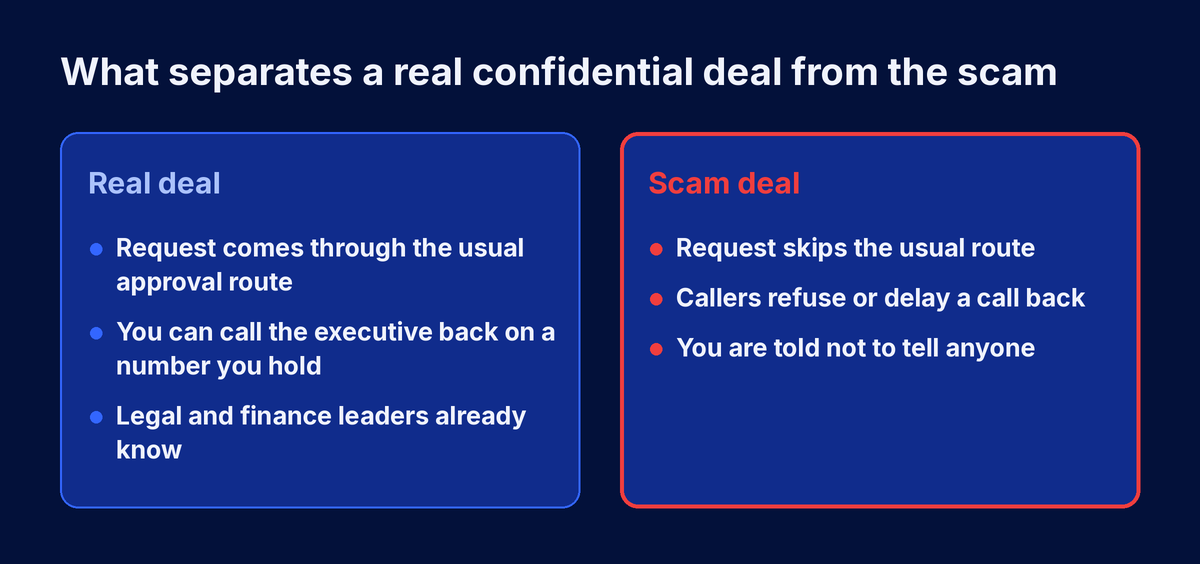
Teach the signal, not the technology. A request that combines urgency, secrecy and an unusual payment or data transfer is the signal, whoever appears to be asking. Employees should treat that combination as a reason to slow down, even when the voice is familiar.
Make the call back routine non negotiable. Before acting on any request that arrives by phone or video, the employee hangs up and calls the person back on a number they already have, from the company directory or a previous contact. Never on a number the caller supplies. If the chief executive is real, they will understand. If the lawyer is real, they will wait.
Give secrecy a named exception. Policies should say plainly that no confidential deal ever requires an employee to bypass payment approvals or to keep a request from their own line manager, finance leadership or legal team. Write that sentence into the policy and repeat it in training, so employees know they will be backed when they break the silence.
Practise the whole script, not one call. A realistic simulation runs both roles. A cloned executive voice introduces the deal, and a second caller follows up with the request, so employees feel the pressure building across two conversations. Run it only for employees who have consented to the training programme, keep the requests harmless, stop the moment the employee asks, and tell them straight away that it was a simulation and what they could have spotted.
Protect the people who are imitated. Executives with a public voice and face are the easiest to clone. Agree with their assistants and finance teams how a real request from them will always arrive, and treat that agreement as part of deepfake executive protection, not only as a payment control. Our post on how much audio it takes to clone a voice explains why public recordings matter.
Read the results by process, not by person. If one team keeps acting on the request, look first at the workflow that lets an urgent call skip a check. A process that allows payments to bypass a second approver because someone senior said so will keep producing the same result, whatever the training says.
Deepfake CEO fraud with a fake lawyer works because it borrows trust from two directions and then removes the colleague who would have asked a question. Employees who know that secrecy and urgency together are the warning, and who always call back on a number they already hold, stop it at the first step, however real the voices sound.
Frequently Asked Questions
Q: What is deepfake CEO fraud?
A: Deepfake CEO fraud is a scam in which an attacker uses a cloned voice or a live face swap to impersonate a chief executive and persuade an employee to make a payment or share sensitive data. Newer versions add a second impostor, such as a lawyer, who handles the actual request.
Q: Why do attackers use a fake lawyer alongside the deepfake executive?
A: Splitting the roles lets each impostor vouch for the other. The cloned executive only makes an introduction, so there is little for the employee to question, and the lawyer arrives already trusted. The lawyer also supplies a reason for secrecy, which keeps colleagues from seeing the request.
Q: How can employees spot a deepfake CEO scam on a call?
A: Employees should focus on the request rather than the voice. Urgency, secrecy and an unusual payment or data transfer together are the warning sign. The reliable check is to hang up and call the executive back on a number already held by the company, never one the caller supplies.
Q: What should deepfake CEO fraud training include?
A: It should teach the urgency and secrecy signal, a mandatory call back routine, and a policy stating that no deal justifies bypassing approvals. Realistic simulations that run both the executive and the follow up caller, with consent and an immediate debrief, let employees practise the routine under pressure.
Try the demo before you train
Before you train employees on this scam, try the free deepfake security training demo yourself. Then read how protecting your leaders fits into a wider programme on the deepfake executive protection page.
Share this article
Found it interesting? Don't hesitate to share it to your friends or colleagues