
TL;DR: A voice phishing scam is a phone call in which an attacker poses as someone trusted, such as a bank, the IT help desk, a supplier or a senior colleague, and asks for money, a code, a password reset or data. It lands because the call feels personal, the caller sounds sure and the request comes with a deadline. Voice phishing scam training works when employees practise one routine on realistic calls. Pause any unusual request, hang up, call back on a number you already have, and report the call.
Why voice phishing scams reach everyone, including at work
Scam calls are a familiar part of ordinary life. Many of them rely on social engineering rather than any technical trick, and the phone suits that well, because a voice on the line can build trust and pressure in a way a message cannot.
The same people who get those calls at home are your employees. The scammer who pretends to be a bank on a Saturday can pretend to be the IT help desk on a Monday. The skills are the same and so is the target, a person who wants to be helpful and does not want to get in trouble.
That is why a voice phishing scam is a workplace risk and not only a consumer one. An employee who reads a code aloud, approves a login prompt or changes a supplier's bank details on the strength of one phone call can hand an attacker far more than their own savings.
This post explains how a voice phishing scam is built, why it works so well, and how to train employees so that the call ends with a check rather than a loss. If you want the basics first, our guide to what vishing is covers the term and its history.
How a voice phishing scam is built
Most scam calls follow the same shape, whatever the story on the surface. Knowing the shape is more useful than memorising stories, because the stories change every month and the shape does not.
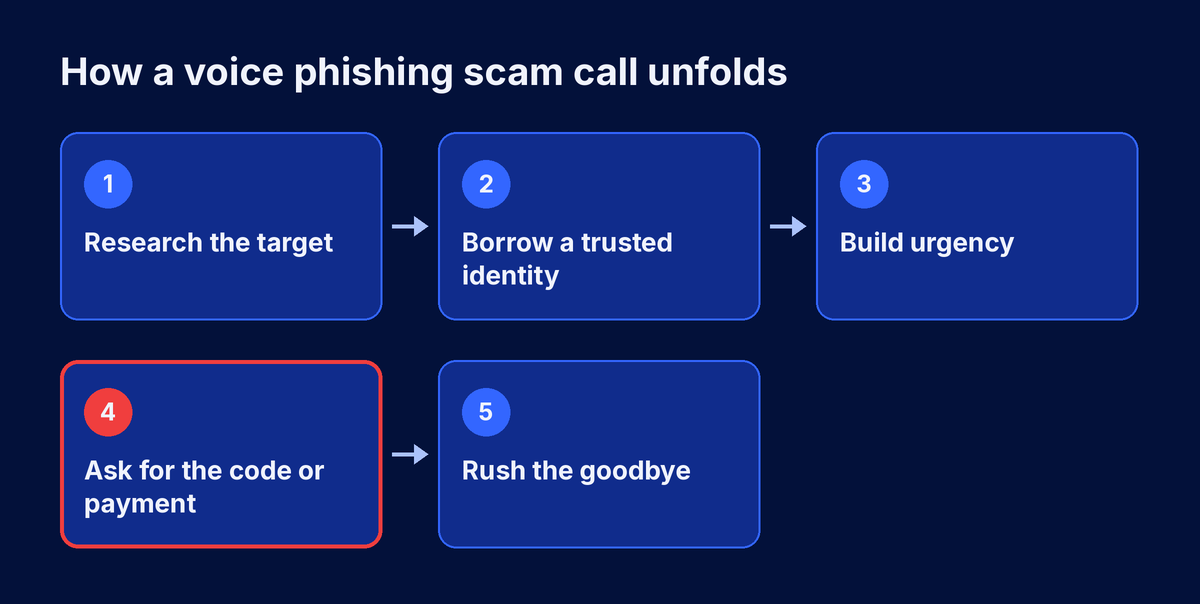
Research. The caller learns a few facts in advance. A name from a professional profile, the name of the help desk tool from a job advert, a supplier from a press release. A few accurate details make the call feel genuine.
A trusted identity. The caller claims to be someone the employee has a reason to obey or help. The bank's fraud team, internal IT, a courier, payroll, a regular supplier or a senior leader. The number shown on the phone can be spoofed to match, so caller ID proves nothing.
Urgency. There is always a clock. The account will be locked within the hour, the payment misses the supplier deadline, the executive is about to board a flight. Urgency is there to stop the employee from thinking and checking.
The request. Only then does the real ask arrive. Read me the code that has arrived. Approve the prompt on your phone. Install this support tool. Update the bank details on this invoice. Send me the file.
The quick goodbye. Once the caller has what they need, the call ends fast and politely, often with a warning not to discuss it because of an ongoing investigation. Silence buys the attacker time.
Voice cloning adds one more layer. A caller can now sound like a specific person, such as a manager or a finance leader, from a short recording. Our post on how much audio it takes to clone a voice explains why that bar is lower than most people expect.
Why scam calls land with smart people
Employees who fall for a voice phishing scam are rarely careless. The call is designed to work on careful, helpful people, and it uses a few reliable levers.
A phone call is synchronous. There is no time to hover over a link or ask a colleague, because someone is waiting on the line. Silence feels rude, so people fill it by answering.
Authority does a lot of the work. A confident voice that claims to be from security, the bank or the executive office gets the benefit of the doubt, especially from newer employees who do not yet know who is who.
Helpfulness is turned against the target. Help desk agents, assistants and finance teams are rewarded for solving problems quickly. A scam call presents a problem that can be solved right now, by them, if they bend one rule.
Fear closes the gap. The story usually carries a threat to the employee's own position, such as a frozen account, a missed payment or an awkward conversation with a senior leader. People under that pressure act first and reflect later.
None of these levers depends on a technical weakness, which is why software alone does not stop the scam. It depends on what the person on the line does next.
What voice phishing scam training should teach
Good voice phishing scam training is narrow on purpose. It does not try to turn employees into fraud investigators. It teaches one routine that works whatever the caller says, and gives people enough practice that the routine becomes automatic.
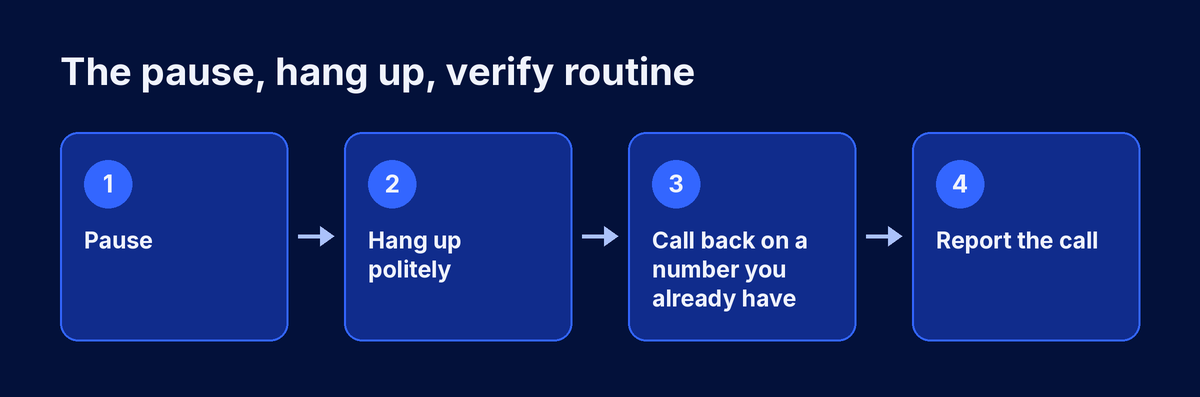
Pause. Treat any unusual request made by phone as a signal, whatever the caller's name. A request for a code, a password reset, a new payee or a file is the trigger, not the story around it.
Hang up. Ending the call is allowed, even if the caller sounds senior. Employees need to hear from leadership that a polite hang up will never get them in trouble.
Call back. Verify through a number or channel you already have, such as the company directory, the number on the back of a card or the supplier record on file. Never use a number the caller gives you.
Report. Tell the security team, even if nothing was shared. One report can warn a whole team before the same caller reaches them.
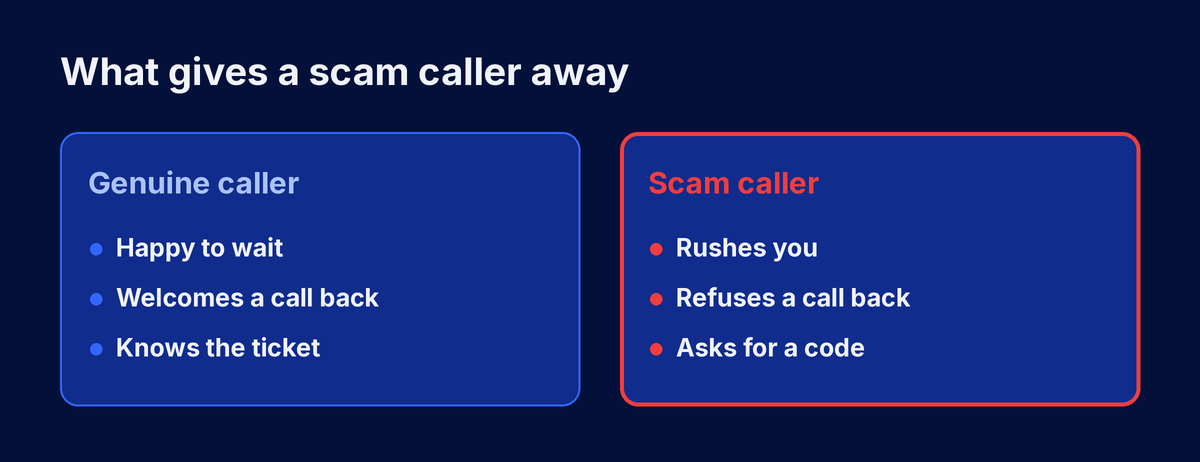
Alongside the routine, teach the signals that should prompt it. A spoofed number that looks internal. A caller who refuses a call back. A request to keep the call secret. Pressure that rises when the employee hesitates. Our page of vishing examples collects common scripts that are useful for discussion.
Practising on realistic calls
Reading about a scam call is not the same as taking one. The pressure, the confident voice and the ticking clock are what make people slip, and those are exactly what a slide cannot reproduce.
That is the role of a voice phishing simulation. Employees agree to the training programme in advance, then receive a realistic call built on an ordinary pretext, such as a help desk reset or a payroll change. The caller stops as soon as the employee asks to end the call. We recommend telling the employee afterwards that it was a simulation and what they could have checked, either on the call or in a follow up email.
Run it in rounds. Start with a pretext that matches each team's real work, so finance hears payment requests and the help desk hears reset requests. Record whether each employee shared what was asked, refused, or paused and verified. Verification is the outcome you are training for.
Read the results by team rather than by person. If one group shares more often, look at its process first. A workflow that allows urgent exceptions over the phone will keep producing the same result whatever the training says. Fix the process, then run the next round with a different story. The same approach carries over to cloned voices and video calls in deepfake security awareness training.
For a fuller view of how a programme fits together, see our guide to vishing training, or try the voice phishing simulator to hear what a simulated call sounds like.
A voice phishing scam succeeds in the few seconds between a confident request and an employee's reply. Training that gives employees a routine they have already practised on a realistic call turns those seconds into a pause, and a pause is usually all it takes for the scam to fail.
Frequently Asked Questions
Q: What is a voice phishing scam?
A: A voice phishing scam is a phone call in which an attacker poses as a trusted person or organisation, such as a bank, the IT help desk, a supplier or a senior colleague, to persuade the person who answers to hand over money, a code, a password reset or confidential data.
Q: How do you train employees to spot a voice phishing scam?
A: Teach one routine and practise it. Pause any unusual request made by phone, hang up politely, call back on a number you already have, and report the call. Then run realistic simulated calls, with consent to the programme in advance, so employees practise the routine under real pressure.
Q: Can caller ID be trusted on a suspicious call?
A: No. Scammers can make a call display almost any number, including one that looks internal or matches a real bank. Caller ID tells you what the caller wants you to see. Verify by calling back on a number you already hold, never one the caller supplies.
Q: Why do voice phishing scams work on careful people?
A: The call is built to remove thinking time. It uses authority, helpfulness, fear and a deadline while someone waits on the line. Careful people are still helpful people, and the scam turns that helpfulness into the vulnerability. A practised routine gives them a safe way out.
See it before your employees do
Start with the free deepfake security training demo to see the kind of impersonation employees now face. Then explore how a vishing simulation programme gives employees practice in pausing and verifying.
Share this article
Found it interesting? Don't hesitate to share it to your friends or colleagues