
TL;DR: Security awareness training for deepfakes extends an existing programme from email to the phone and the video call. Start with the teams that move money, reset access or handle executive requests. Teach one habit, pausing an unusual request and confirming it through a channel the employee already trusts. Practise it on simulated calls that employees have consented to, with a debrief straight after each call. Measure verification rather than detection, read results by team, and change the processes that let urgent requests skip a check.
Why security awareness training stops at the inbox
Most organisations already run a security awareness programme. Employees watch a short module each quarter, receive the odd simulated phishing email, and learn to hover over links before they click. That work is useful. It also covers only one channel.
Deepfake attacks arrive somewhere else. A cloned voice rings the finance team and asks for a payment before a deadline. A help desk agent hears a familiar colleague who has lost access and needs a reset. A video call shows a senior leader who wants a confidential file sent straight away. None of these involve a link to hover over, and none of them look like the examples in an email module.
The good news is that you do not need a new programme. You need a deepfake module inside the one you already have, with the same governance, the same reporting and the same habit of repeating the lesson. This post sets out a rollout plan for that module, in the order we would run it.
Who should take deepfake training first?
Not every employee faces the same calls. Start where a convincing voice or face would cause the most damage, then widen the circle.
The first group is the teams that move money. Accounts payable, treasury and anyone who can change a supplier's bank details are the classic target of a cloned executive voice. The second group is the teams that reset access. Help desks and service desks are asked to reset passwords and multi factor authentication every day, often by phone, which makes them a natural entry point for an attacker who sounds like a colleague. The third group is the people around executives. Executive assistants handle diaries, travel and documents, and they are used to urgent requests from the person whose voice is easiest to clone.
Starting with these groups keeps the first round small enough to run well. It also produces results that leadership cares about, because they map directly to fraud, account takeover and data loss.
Put the call back rule in place before the module
A rollout goes wrong when the module teaches a habit the organisation does not support. If employees are told to pause and call back, but the payment policy lets urgent changes through on a phone call, the training and the process pull in opposite directions, and the process usually wins.
So agree the rule before the first call is placed. Every change of bank details, every reset requested by phone and every unusual file request is confirmed through a channel the employee already trusts, such as a number from the directory or a message in an internal system. Write it into the relevant policies, and make sure managers know about it. Our post on how much audio it takes to clone a voice explains why this rule matters more than any tip for spotting a fake.
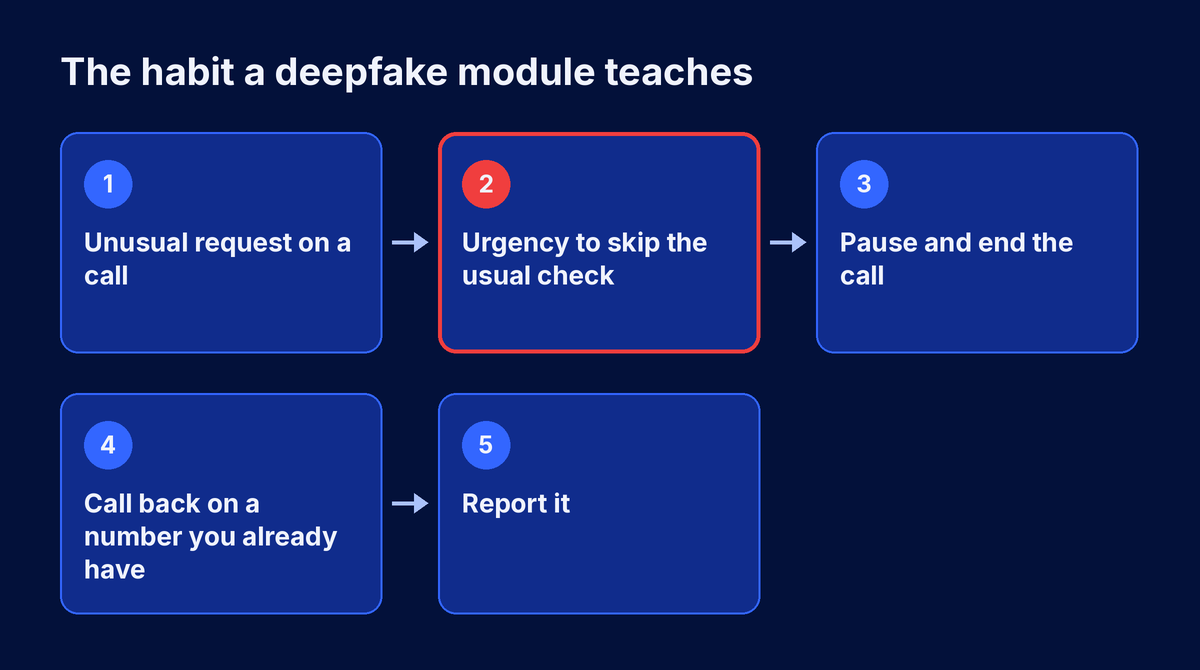
With the rule in place, the employee who pauses is following policy rather than challenging a senior leader. That makes the habit far easier to practise, and it gives the module a clear standard to measure against.
How to run the first round
A deepfake module needs practice, not only content. A slide about cloned voices tells employees the threat exists. A simulated call lets them feel how persuasive a familiar voice in a hurry can be, which is the feeling they need to recognise when it matters.
Run the first round in four steps. First, get consent. Employees agree to the training programme before any call is placed, and anyone whose voice or likeness is imitated authorises it in writing. Second, pick ordinary pretexts that match each team, such as a supplier payment for finance or a locked account for the help desk. Third, place the calls, and make sure the caller stops the moment an employee asks it to. Fourth, debrief straight after the call, showing the employee what they could have checked and how to check it next time.
Keep the scenarios dull. Real attackers use urgent but believable requests, and an employee who learns to pause on a routine request will pause on the next one too. A dramatic, far fetched story teaches very little about the call that will really come.
How do you measure a deepfake module?
Record one of three outcomes on every call. The employee shared what was asked, refused, or paused and verified through a trusted channel. Verification is the outcome you are training for, so track how often it happens across rounds.
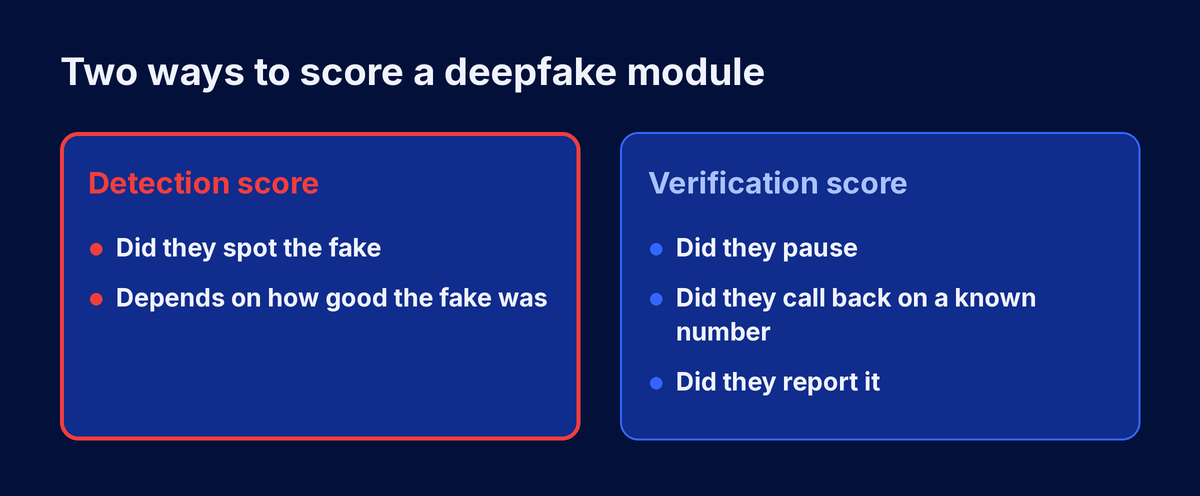
Read the results by team rather than by person. If one team shares more often than another, look at its process before its people. A workflow that lets urgent exceptions through on a phone call will keep producing the same result whatever the training says, and fixing that workflow is often the most valuable outcome of the whole exercise.
Then repeat. One round is a snapshot. Several rounds with different pretexts, spaced over a few months, are what turn a lesson into a habit. Add teams in each round, and fold the results into the same reports your board already sees for email phishing, so deepfake risk sits next to the rest of your human risk rather than in a separate document.
Fitting it into the programme you already run
The module should look like the rest of your programme. Use the same consent process, the same reporting cycle and the same owner. Schedule it alongside your email simulations rather than in place of them, because attackers often combine the two, sending an email first and calling to add pressure.
Brief managers before the first round. Employees who verify a request from a senior colleague need to know they will be thanked for it, not reprimanded. That message works best when it comes from leadership, ideally from an executive whose voice is likely to be imitated.
For a fuller picture of what the programme can include, see our page on deepfake security awareness training, and try the free deepfake security training demo yourself.
Security awareness training already gives employees good instincts about email. A deepfake module extends those instincts to the phone and the video call, by practising one habit until it is automatic and by fixing the processes that make that habit hard to follow.
Frequently Asked Questions
Q: How do you add deepfakes to an existing security awareness programme?
A: Add a deepfake module rather than a new programme. Use the same consent process, owner and reporting cycle, agree a call back rule first, start with a small round for the riskiest teams, and schedule it alongside your email simulations so deepfake results sit next to the rest of your human risk reporting.
Q: Which teams should take deepfake training first?
A: Start with the teams that move money, the teams that reset passwords and access, and the people who support executives. These groups receive the urgent requests attackers imitate most often, so a small first round with them produces useful results quickly and shows where processes need a call back step.
Q: Should employees be taught to spot deepfakes?
A: Detection tips help a little, but they age quickly as the fakes improve. A verification habit lasts longer. Teach employees to pause any unusual request made by voice or video and confirm it through a channel they already trust, whatever the caller sounds or looks like on the day.
Q: How often should a deepfake module run?
A: Run it in rounds, several times a year, with different pretexts each time. One round shows a starting point. Repeated rounds, spaced over months and read by team, show whether verification is becoming a habit and which processes still let urgent requests skip a check.
See it for yourself
Before you plan the first round, try the free deepfake security training demo yourself. Then read how a full programme fits together on the deepfake security awareness training page.
Share this article
Found it interesting? Don't hesitate to share it to your friends or colleagues