
TL;DR: Voice deepfake phishing training puts employees on a consented, simulated call where an AI voice, sometimes cloned from a familiar person, asks for something unusual. The scenarios decide what employees learn. Start with six ordinary calls, a supplier bank change and an urgent executive payment for finance, a locked account and a new phone for the help desk, a payroll change for HR, and a missing file for executive assistants. Each tests one thing, whether the employee pauses and confirms the request through a channel they already trust.
Why the scenario matters more than the voice
When teams first plan voice deepfake phishing training, most of the attention goes to the voice. Can it sound exactly like the finance director? Will employees notice the clone? Those questions are interesting, but they are the wrong place to start.
The voice gets the caller through the first ten seconds. The scenario decides everything after that. It sets who the caller claims to be, what they want, why it cannot wait, and which normal check they ask the employee to skip. A perfect clone with a far fetched story teaches very little. An ordinary request in a familiar voice, made on a busy afternoon, teaches the lesson that matters.
This post sets out six scenarios to run first, grouped by the team that receives them. Each one is dull on purpose, because real attacks are dull. For each, we note what it tests and what the debrief should cover. If you want to hear how convincing a cloned voice is before you design anything, our post on how much audio it takes to clone a voice is a good place to start.
What makes a good voice deepfake scenario?
Every strong scenario has four parts. A believable identity, such as a supplier, a colleague in IT or a senior leader. A routine request the employee has handled before. A reason it has to happen now. And a nudge to skip the usual check, because the system is down, the leader is about to board a flight, or the employee would be doing them a favour.
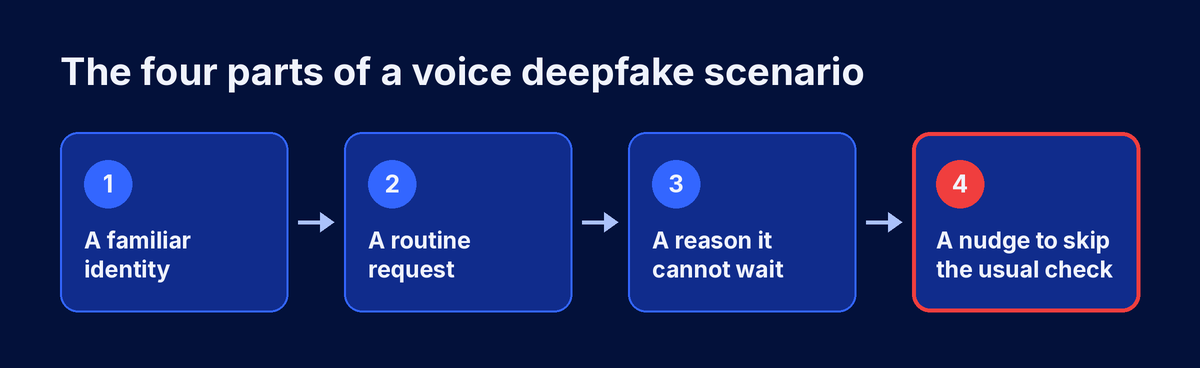
The fourth part is the one you are training against. Employees do not need to learn to refuse routine requests. They need to notice the moment a caller asks them to step outside the normal process, and respond by pausing and confirming through a channel they already trust.
Keep each scenario inside clear limits. Employees consent to the training programme before any call is placed. The caller stops the moment an employee asks it to. And nothing the scenario asks for should cause real harm if it is handed over. The aim is practice for the employee, not a win for the caller.
Two scenarios for finance teams
The first is the supplier bank change. A caller who sounds like a known contact at a regular supplier explains that the company has moved banks and asks for the details to be updated before the next payment run. The test is whether the employee follows the call back procedure to a number already on file, rather than to any number the caller offers.
The second is the urgent executive payment. A cloned voice of a senior leader asks for a payment to close a confidential deal today, and asks the employee to keep it quiet for now. The test is whether secrecy and seniority together are enough to bypass the approval process. The debrief should stress that a real leader will be glad the employee checked.
Two scenarios for the help desk
The third is the locked account. A caller who sounds like a colleague says they are locked out before an important meeting and need their password and multi factor authentication reset right away. The test is whether the agent completes the normal identity checks, even when the voice is familiar and the caller is frustrated.
The fourth is the new phone. A caller explains they have replaced their phone and need their authenticator moved to the new device. This request sounds harmless and is a known route into an account. The test is whether the agent treats a device change as seriously as a password reset.
Scenarios for HR and executive assistants
The fifth is the payroll change, aimed at HR or payroll teams. A caller who sounds like an employee asks for their salary to go to a new account from this month. The test is whether changes to pay details are confirmed through the employee's known contact details, not through the call itself.
The sixth is the missing file, aimed at executive assistants. A cloned voice of the executive they support says they are about to present and cannot open a board document, and asks for it to be sent to a personal address. The test is whether the assistant confirms through a channel they already use with the executive, such as an internal message.
How to debrief each scenario
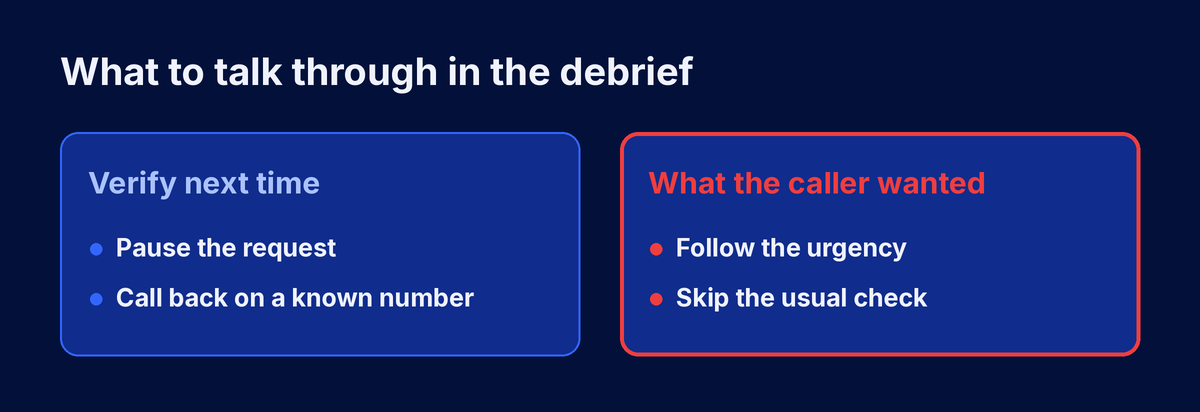
The debrief happens straight after the call, while the employee still remembers how it felt. Tell them it was a simulation, point to the moment the caller asked them to skip a check, and show the habit that would have stopped it. Keep it short and kind. An employee who feels caught out learns less than one who feels coached.
Then read results by team rather than by person. If finance shares on the supplier scenario more than on the executive one, the supplier process probably has a gap. Fix the process, run a new round with fresh pretexts a few months later, and track how often employees verify. Read more about how the training works on our page about voice deepfake phishing training, and see how it fits a wider programme on the deepfake security awareness training page.
A cloned voice is only the opening move. The six scenarios above train employees for what comes next, the ordinary request with a reason to skip the check, and they give you results that point straight at the processes worth fixing.
Frequently Asked Questions
Q: What is voice deepfake phishing training?
A: It is training that puts employees on a consented, simulated phone call where an AI voice, sometimes cloned from a familiar person, asks for something unusual. After the call, employees are shown what gave it away and how to confirm a request through a trusted channel, so they pause on the next real one.
Q: Which voice deepfake scenarios should you run first?
A: Start with ordinary requests that match each team's work. A supplier bank change and an urgent executive payment for finance, a locked account and a new phone for the help desk, a payroll change for HR, and a missing file for executive assistants. Each tests whether the employee pauses and verifies.
Q: Should the simulated caller use a cloned voice of a real executive?
A: Only with that executive's written authorisation, and only after employees have consented to the training programme. A stock AI voice works well for supplier and colleague scenarios. Save a cloned executive voice for the scenarios where seniority is the pressure being tested, and involve your legal and privacy teams first.
Q: How do you measure voice deepfake phishing training?
A: Record whether each employee shared what was asked or refused, and use the debrief to learn whether they thought to verify through a trusted channel. Read the results by team and by scenario, fix the processes that let urgent requests skip a check, and repeat with fresh pretexts to see whether verification becomes a habit.
Hear the call before your employees do
Take the free deepfake security training demo yourself. Then pick the two scenarios that match your riskiest team and plan your first round around them.
Share this article
Found it interesting? Don't hesitate to share it to your friends or colleagues