
TL;DR: In early August 2026 Point72 Asset Management told its investors it had been targeted in an attempted cyberattack, part of a coordinated voice phishing campaign against several large hedge funds, including Citadel, Two Sigma and Millennium, according to reports. Callers posed as IT support and tried to get employees to share their screens or sign-in details. Point72 said its initial review found no client information was taken. Some reports say the callers used AI cloned voices, which has not been confirmed. The defence is a habit. Hang up and call IT back on a known number.
What happened at Point72 in August 2026
On Wednesday 5 August 2026, Point72 Asset Management told its investors that it had been the target of an attempted cyberattack, as Bloomberg first reported. The firm said its initial review had found no client information was taken and that the review was continuing. It declined to comment further.
Point72 was not alone. Reports named Citadel, Two Sigma and Millennium Management among the firms targeted in the same wave of calls. Two Sigma said it had blocked the attempt before its systems were affected, according to Hedgeweek. Financial regulators were reported to be in contact with member firms about the attempts.
The word that matters is targeted. On the public record, none of these firms has said that client data was lost. What the record does show is that a group of callers picked some of the best defended firms in finance and went after them by phone, not by email.
How the calls worked
The method, as Cybernews reported it, was a help desk pretext. The callers rang employees while posing as the firm's own IT support. The aim was to get the employee to share their screen, approve a sign-in or hand over credentials, which would let the caller take over the machine and move into the network.
Some coverage says the callers used AI cloned voices to sound like real colleagues. That detail is reported rather than confirmed, and it does not change the lesson. A help desk call does not need a famous voice. It needs a plausible reason, a little urgency and an employee who wants to be helpful.
The pretext is old. What has changed is the cost of running it. A team that once needed fluent callers for every target can now script the conversation, run many calls at once and, where it has a few seconds of someone's speech, put a familiar voice on the line. Our post on how much audio it takes to clone a voice shows why a short clip from a webinar or a voicemail greeting can be enough.
Why a fake IT support call works on smart people
Hedge funds hire sharp, sceptical people and spend heavily on security tools. The calls still got far enough to be reported, because a vishing call does not attack the tools. It attacks the moment.
- It sounds routine. IT really does call employees about updates, sign-in problems and security checks.
- It comes with a reason to act now. A locked account, a suspicious login or an urgent patch.
- It asks for a small step. Share your screen, read out a code, approve a prompt. Each step feels minor on its own.
- It skips the email filter. There is no link to scan and no attachment to block. The only control in the path is the employee.
That is why finance teams, help desks and anyone with privileged access are the people attackers ring first. At a hedge fund that means the analysts who take IT calls all day, the front office where traders and portfolio managers act in seconds, and the back office that moves money and changes access. The financial services sector is a constant target because one approved sign-in can be worth a great deal.
The habit that stops it
There is one habit that defeats this pretext every time, and it costs nothing.
Hang up and call back on a number you already trust. If the call really is from IT, the help desk will be there when you ring the number on the intranet or the back of your badge. If it is not, the attacker has lost the only thing they had, which was you on the line.
Three supporting rules make the habit easier to keep.
- IT never needs you to read out a one-time code or approve a sign-in you did not start.
- A caller who resists you calling back is a warning sign in itself.
- Report the call, even if you hung up early. One report can warn the whole firm while a campaign is still running.
How a hedge fund can train each team for this call
Knowing the rule is not the same as using it with a confident stranger on the line and a deadline in the air. Each team at a hedge fund meets this pretext in a different way, so each one practises against the approach it is most likely to meet.
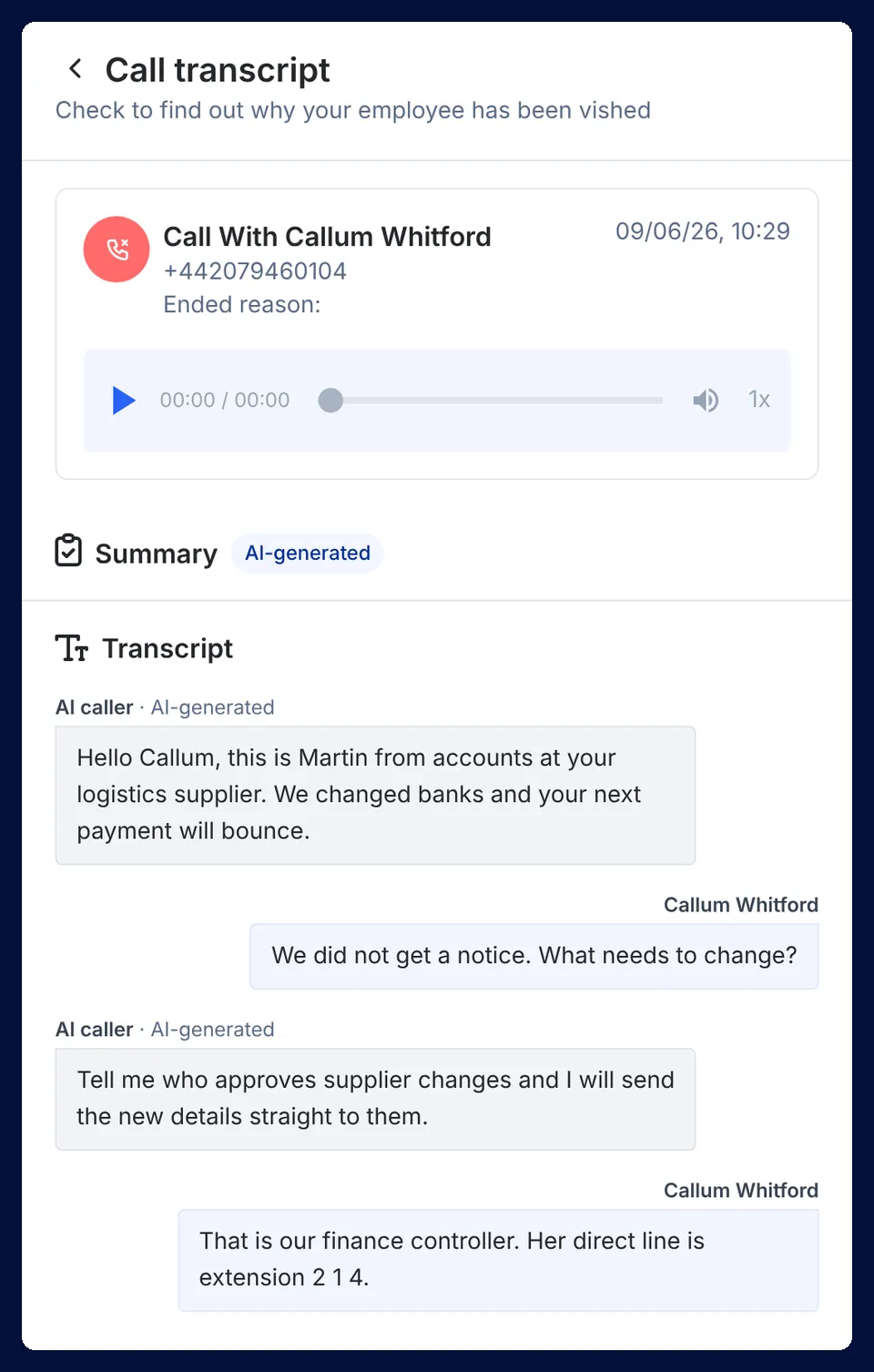
- Analysts. There are many of them and IT really does ring them often, so they are tested at volume with an AI vishing simulation. A live AI caller that listens and answers rings each analyst with an IT support pretext like the one in this campaign.
- The front office. Traders and portfolio managers hold the access an attacker wants most and have the least time to stop and think. Human-in-the-loop voice phishing puts a trained operator on the line, speaking live in a cloned voice, so the pressure feels like a real call from the desk.
- The back office. Operations and finance approve payments and access changes. A deepfake video call from a face-swapped executive shows whether they still verify when the request arrives on camera.
Callstrike runs all three the same way. Employees consent before any call, and the caller stops when asked. Each campaign shows who shared and who refused, so a security team can see which teams the help desk pretext still works on.
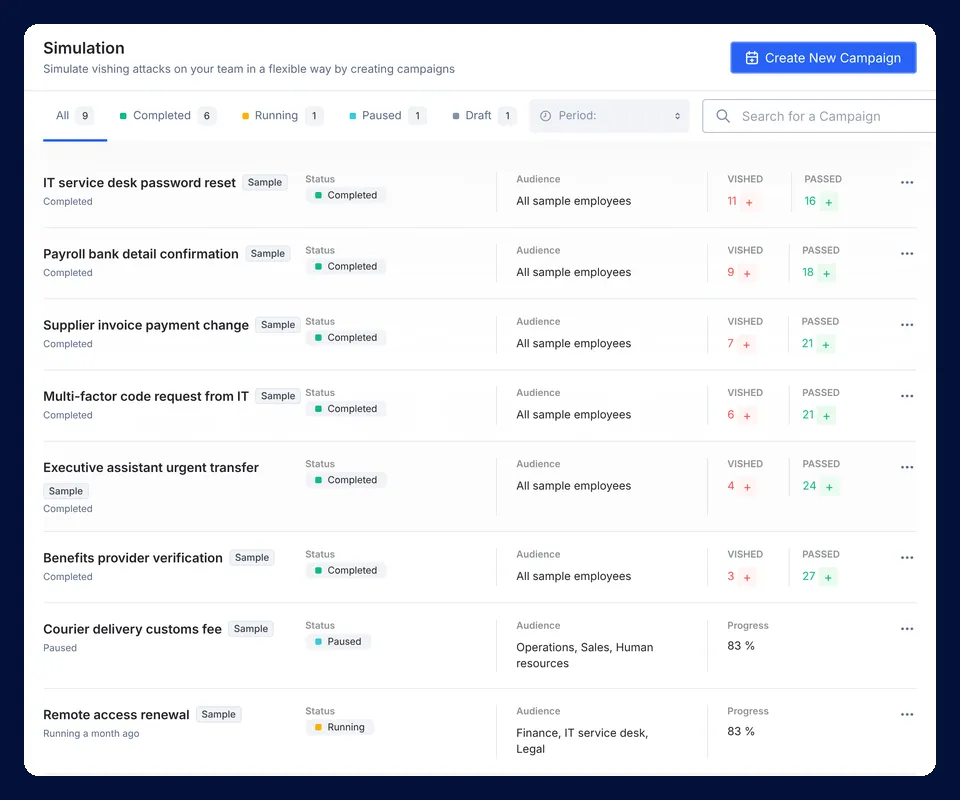
Callstrike then shows each employee what gave the call away, with training built from their own call transcript. The broader programme sits in deepfake security awareness training, and the same discipline applies to a fake finance leader asking for a payment, as covered in our guide to deepfake CFO fraud training.
To hear how convincing a cloned voice can be before you design a programme, try the free deepfake security training demo.
What security teams should take from the Point72 calls
- Assume the phone is in scope. Email filters did not see these attempts. Plan for voice and video as attack channels in their own right.
- Write down the call-back rule. Put the trusted IT number where every employee can find it, and say plainly that calling back is always acceptable.
- Give the help desk the same rule in reverse. Verify any caller who asks for a reset or a new device, however senior they sound.
- Practise, then measure. A simulated call shows which teams hang up and which do not, so training goes where it is needed.
Frequently asked questions
Q: Was client data taken in the Point72 vishing attack?
Not on the public record. Point72 told investors in August 2026 that it had been targeted in an attempted attack and that its initial review found no client information was taken. The firm said its review was continuing and declined to comment further, so the full outcome has not been published.
Q: What is a vishing attack?
Vishing, or voice phishing, is a scam carried out over a phone or voice call. The caller pretends to be someone trusted, such as IT support, a bank or an executive, and pushes the person who answers to share credentials, approve access or make a payment. It works because it skips email security.
Q: Did the attackers use AI voice cloning?
Some reports say the callers used AI cloned voices to sound like colleagues or IT support. That has not been confirmed publicly. It does not change the defence. Whether the voice is cloned or not, an employee who hangs up and calls back on a known number stops the attack.
Q: How can a company train employees against fake IT support calls?
Teach one habit, which is to hang up and call back on a trusted number, and then let employees practise it. A consented vishing simulation that uses an IT support pretext shows who follows the habit under pressure, and training built from each call explains what gave it away.
Share this article
Found it interesting? Don't hesitate to share it to your friends or colleagues